
Incineration & Energy from Waste
Incinerators can be described by the origin of the waste, the nature of the waste and/or the method of incineration [1]. The method of thermal treatment (for example Combustion/Conventional Thermal Treatment, or Advanced Thermal Treatment such as Gasification and Pyrolysis) can have different technologies associated with the way waste is introduced and managed in the system (such as grate systems, fluidised bed systems and rotary kiln systems).
Some incinerators produce little or no energy and are focused on the disposal of waste alone. Those incinerators that generate electricity and/or heat that meet higher levels of efficiency, can be classified as an R1 Recovery Facility[2].
Types of Incineration and EFW
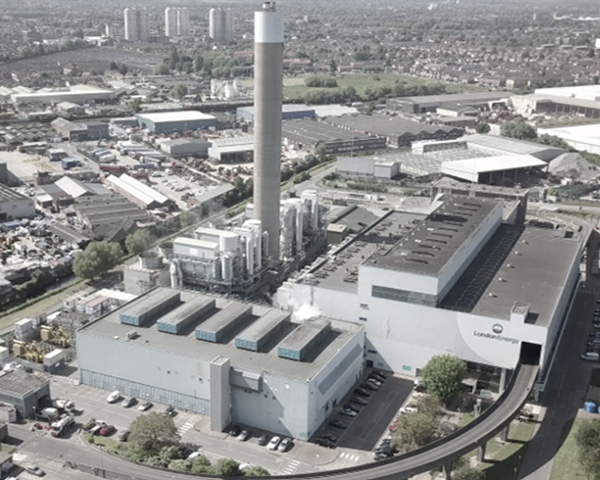
There are four main types of Incineration and EfW in WikiWaste, with a further type of Cement Kilns which co-fire waste. Small incinerators are presently not captured in the listing of sites under each type:
Residual EfW facilities treat primarily household and commercial wastes that are not recycled or that have been pre-treated to produce a Refuse Derived Fuel (RDF).
Biomass EfW facilities treat a range of biomass-rich wastes, with a focus on Waste Wood, Meat and Bone Meal (MBM), Agricultural Wastes and Sewage Sludge.
Clinical Waste Incinerators primarily treat Healthcare Wastes at high temperature to ensure the destruction of micro-organisms, medicines and other human and animal tissues containing hazardous substances.
High-temperature facilities that are focused on Chemical Wastes and the destruction of Hazardous Waste streams under specialised handling arrangements and strict regulatory controls.
Cement Kilns have progressively replaced raw materials and coking coal with selected mineral wastes and combustible wastes (including tyres, solid Recovered Fuel (SRF), and hazardous Chemical Wastes.
USE and HSE Incineration
Future listings in WikiWaste will consider Small Waste Incineration Plants (SWIP) whose permits are often issued by Local Authorities. These facilities typically include those classified as Ultra-Small Emitters (USE) and Hospital Small Emitters (HSE) under the UK ETS.
Future listings in WikiWaste will consider Small Waste Incineration Plants (SWIP) whose permits are often issued by Local Authorities. These facilities typically include those classified as Ultra-Small Emitters (USE) and Hospital Small Emitters (HSE) under the UK ETS.
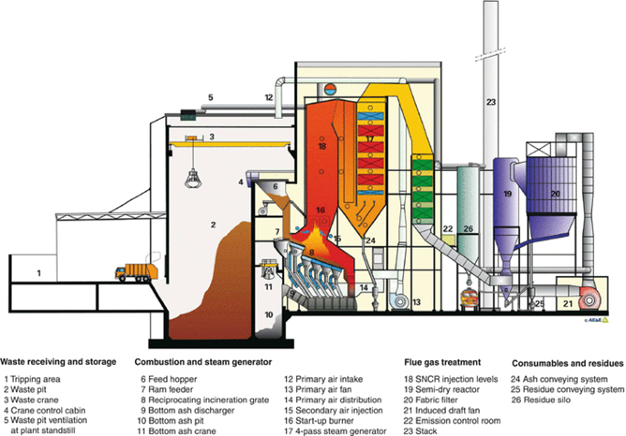
Cross Section of Residual Waste EfW Facility
Notes
The key elements of an incinerator are set out below. The cross section[3] represents a combustion approach to incineration (the dominant approach in the UK):
- Waste Reception and Storage
- EfW Technology (for example Grate as shown here)
- Steam Generation
- Power Generation (from steam)
- Gas clean Up
- Botton Ash residues
- Fly Ash/APC Residues
Approach to Incineration
There are three core approaches to incineration (or 'Thermal Treatement') as listed below. Combustion is by far the most prevalent approach. Gasification and Pyrolysis (also termed Advanced Thermal Treatment and Advanced Conversion Technology) have had limited success where used in the UK to date. They are used to create a syngas that can then be used to generate heat and electricity, but are the core approach for conversion to produce alternative fuels (for example jet fuels and hydrogen).
Technologies Used by Incineration Plants
Incinerators comprise a number of specific elements as part of the overall plant design and delivery, but the main technology is that used to introduce the waste into the plant, and then introduce the heat into the waste (listed below). The most common technologies are Grate based (there are at least five different type of Grate), with a Fluidised Bed technology more commonly used in Gasification. For the treatment of Hazardous Waste the more common technology is based on Rotary Kilns.
Power Generation
The energy produced by an EfW facility can either be converted to electricity to boost the National Grid and/or provide heat in the form of hot water or steam for use by nearby developments. The renewable content of residual waste is elidgble for some subsidies[5].
A plant facilitating the generation of electrical power and recovery of usable heat is termed a Combined Heat and Power (CHP) plant and it is more efficient than one focused on power generation alone.
The steady, consistent electrical power generation - also termed base load power - by Residual Waste EfW plants accounts for 3% of UK power generation.
Emissions
The standards for emissions limits, monitoring, waste reception and treatment standards that are acceptable for waste incineration plants were set in the Waste Incineration Directive (2000/76/EC) and updated in the Industrial Emissions Directive (2010/75/EU)[4]. The Industrial Emissions Directive provides the framework for regulating across the EU and requires such installations to hold a Permit based on the use of Best Available Technique (BAT).
On the 3rd December 2019 new EU standards were published for waste incineration [1] for new emissions, monitoring and efficiency standards. The new specifications stem from a review of Best Available Technique (BAT) Reference Document (BREF) for Waste Incineration.
In 2025 it was announced that the UK ETS was to be applied to incinerators, having previously been excluded, with some exemptions for smaller facilities. The MRV period runs from January 2026 to December 2027. Many facilities are considering their carbon emissions and the possible implementation of Carbon Capture Systems (including CCUS).
Output - Bottom Ash
The type and amount of residue left after incineration will depend on the waste input and the incineration approach.
The residue from combustion of primarily MSW waste in a Residual Waste EfW facility is an Incinerator Bottom Ash or IBA which is generally around 20% of the input tonnage and which will comprise a small proportion of metals.
IBA is increasingly being processed to remove the metals and produce a Secondary Aggregate (termed Incinerator Bottom Ash Aggregate or IBBA).
Outputs - APC Residues
The combustion gases from incineration are cleaned in several stages to comply with the Industrial Emissions Directive (IED).
This gas cleaning results in a residual Flue Ash which is around 3% of the overall input to the plant by weight for Residual Waste EFW depending on the level of gas cleaning required.
APC Residues contain ash, carbon and lime in varying quantities and is considered a Hazardous Waste to be disposed of in a Hazardous Landfill, or sometimes to be further processed through washing or stabilisation in order to make it a non-hazardous waste and allow it to be disposed of in a Non-hazardous Landfill.
Fly Ash and Air Pollution Control (APC) residues are often combined.
Links to
The Incineration & EfW category is designed to be read in context with other parts of WikiWaste:
- Local Authorities – showing which disposal and collection authorities send material to particular Incinerators
- Market Approaches – including the key legislative and economic arrangements for each category of incinerator
- Waste Types – linking the specific waste types to the incinerator types that handle them
- Organisations – associating facilities with operators, local authorities, regulators and sector bodies
Purpose
Use this page to understand the main Incineration & EfW types used in WikiWaste, see how these types sit alongside one another, and navigate to individual facility- and organisation-level views where more detailed data becomes available.
Approach
The Incineration & Energy from Waste (EfW) category groups facilities that thermally treat different waste streams and links them to Waste Types, Local Authorities, Organisations and Market Drivers and Approaches.