

Composting
The Composting category groups facilities that biologically treat suitable organics in the presence of oxygen — primarily green waste and, in some cases, food and other organics — to produce compost outputs for use on land and in landscaping.
This includes Windrow composting facilities, In-vessel Composting (IVC) facilities and other permitted composting configurations. These routes sit alongside Anaerobic Digestion in treating organic wastes and links back to the Organic Waste category in the Waste Types section.

Types within Composting
Composting is divided into three types that reflect process type, permitted inputs and sites that combine organics treatment approaches. These can be viewed individually or together to understand how green waste and other organics are treated across the UK.
Also known as Open Air Windrow Composting (abbreviated to both OAW and OWC) facilities primarily treat green and garden waste in open windrows, typically under permit conditions that largely exclude animal by-products and certain food wastes. Often linked to dedicated garden waste collections from local authorities.
IVC plants treating mixed food and green wastes, operating in enclosed systems that provide temperature and process control and compliance with animal by-products for certain food and animal wastes. Commonly used where local authorities collect green waste mixed with food waste (separate food waste collections typically being routed to treatment via AD.
Combination/Hybrid Sites
Sites that combine IVC and open windrow stages, and in some cases also include AD, to treat a range of organics while achieving required process controls for inputs and quality standards for outputs. They often also include the processing of waste wood.
Sites that combine IVC and open windrow stages, and in some cases also include AD, to treat a range of organics while achieving required process controls for inputs and quality standards for outputs. They often also include the processing of waste wood. The compost produced, in order to be used as a product, must meet PAS100 quality protocol.
Compost Temperatures for Treatment
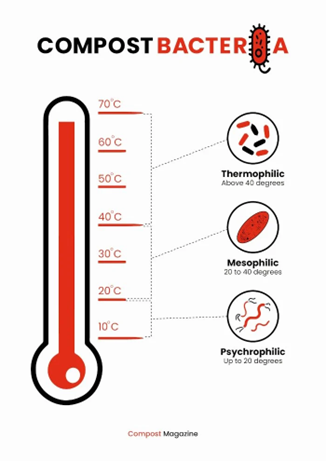
Compost Process
- Composting is the breakdown of organic material in the prescence of oxygen - a process of aerobic digestion (as opposed to Anaerobic Digestion where breakdown of organic material is in the abscence of oxygen)
- Composting of green waste, garden waste, parks and gardens, and similar wastes can be undertaken in open air windrows which need to be turned regularly to introduce oxygen and maintain temperatures at around 50 to 60 degrees for a minimum of 8 days (although the overall process is around 12 to 16 weeks)
- Composting of green waste and similar waste mixed with food needs to be undertaken in an enclosed environment (In Vessel Composting - IVC) and oxygen needs to be introduced to maintain a temperature of at least 70 degrees for an hour and 60 degrees for 2 days to comply with Animal By-products Regulation. IVC sites can vary in scale and and approach to creating the enclosed environment and introducing oxygen, After strict temperature controls and times are met the resulting compost can be treated in OAW for a further 10 to 14 weeks
Historical Context
The growth in Composting of Green Waste has underpinned around half of many local authorities recycling performance in the past as landfill tax increased costs and pushed this material up the waste hierarchy.
Increasingly local authorities are charging for the collection of green waste, which has seen some drop in tonnage.
Potential Changes
The introduction of Simpler Recycling in England, and similar initiatives in other countries of the UK, requires the separate collection of food waste from Green Waste. Whilst it may be possible to continue to collect Green Waste and Food Waste together, and send to IVC (under TEEP) it is likley that more separately collected food will go to AD and green waste to OAW, leadng to a drop in tonnage to IVC in the future.
Links to
Composting is designed to be read in context with other parts of WikiWaste:
- Local Authorities – showing which disposal and collection authorities send green and mixed organics to composting facilities, and how this relates to wider organics strategies.
- Systems & Operations – connecting composting roles back to collection systems, contracts, gate fees and service configurations for garden and organics waste.
- Waste Types – linking waste types such as garden waste, organics and certain food waste streams into the composting facilities that handle them.
- Organisations – associating composting facilities with operators, Local Authorities, regulators and sector bodies involved in permitting, quality schemes and policy.
Facility pages indicate where Professional-tier tools are available, including mapped locations, tonnage time-series and simple rankings by throughput or capacity. This allows users to move from:
- a single composting facility to the authorities and contracts linked to it;
- particular organics streams to the composting and AD routes they use; and
- more detailed analyses of regional composting capacity and coverage.
Purpose
Use this page to understand the main composting types, see how they connect to collection systems and Local Authorities, and navigate to facility- and organisation-level views where data is available.
Approach
The Composting category focuses on facilities that treat organic waste streams through controlled aerobic digestion, producing compost or soil improvers that can be used in agriculture, horticulture and landscaping. These routes help divert green waste and, where permitted food waste, away from residual waste streams and landfill.
Within WikiWaste, this category aims to:
- Group composting facilities into clear types based on process type and input material.
- Link composting routes to Local Authority and commercial collection systems for garden, green and food wastes.
- Connect composting back to the Waste Types section, including garden waste, mixed organics and certain food waste streams.
- Highlight tonnage and capacity data where available, noting when figures were last updated and data scope.
Facility pages will indicate the scope of data available for each site, for example whether inputs, outputs, capacities and performance metrics are present together with the year when these data were last updated.
References:
None.