

Construction, Demolition and Excavation Wastes
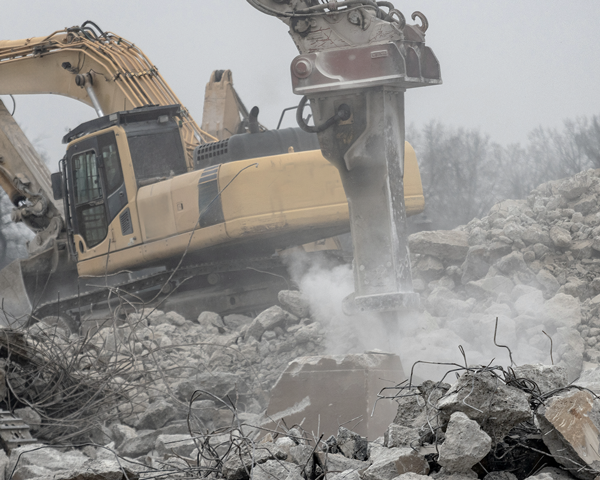
Construction, Demolition and Excavation Wastes (CD&E Wastes) represent around 64% of the overall waste generated by the UK each year. The most recent DEFRA data[1] reported around 123 million tonnes of CD&E wastes.
Tonnages reported for CD&E are open to a considerable degree of interpretation as many construction activities re-use materials on site, or process materials for uses in exempt sites (that do not require tonnages to be reported) that lead to an under-reporting of tonnages. The overall generation of waste in the UK is impacted significantly in any one year by CD&E Waste due to it being a high proportion of the total tonnage.
Many CD&E wastes are processed to create secondary aggregates and are also used extensively in engineering solutions for sites, for example raising ground levels above flood-risk levels.
Types within CD&E Wastes
The CD&E Wastes are broken down in the DEFRA data[1] and grouped in WikiWaste as follows:
Mineral Wastes (from Construction & Demolition)
56.8 million tonnes reported as generated, nearly all from the construction sector (EWC_STAT Code 12.1).
Of this tonnage 0.3 million tonnes (0.5%) were classified as hazardous waste
53.2 million tonnes were reported as treated, 97% of which went to recovery (excluding backfilling) and the balance went to’ land treatment and backfilling’.
Mineral Wastes (from waste treatment & stabilisation)
>0.1 million tonnes reported as generated, this category is mainly a result of treatment (EWC_STAT Code 12.8 and 13).
1.95 million tonnes were reported as treated, of which around 0.5 million tonnes were classified as hazardous waste. Of the total tonnage, 80% went to ‘deposit onto or into land’.
Other Mineral Wastes
7.2 million tonnes reported as generated, 93% from the Mining and Quarrying sector (EWC_STAT Code 12.2, 12.3 and 12.5).
Of this tonnage 0.1 million tonnes (1.4%) were classified as hazardous waste
8.4 million tonnes were reported as treated, 80% of which went to ‘land treatment and backfilling’.
Combustion Wastes
0.7 million tonnes reported as generated, 79% from the Electricity, gas and steam sector, the balance from the wider the manufacturing sector (EWC_STAT Code 12.4).
Of this tonnage 0.15 million tonnes (30%) were classified as hazardous waste
1.2 million tonnes were reported as treated, spit into around thirds of incineration, recovery (except backfilling) and ‘deposit into and onto land’.
Soils
53.1 million tonnes reported as generated, 99% from the construction sector (EWC_STAT Code 12.6).
Of this tonnage 0.4 million tonnes (0.8%) were classified as hazardous waste
48.6 million tonnes were reported as treated, spit into 24% recovery (except backfilling), 23% recovery (including backfilling) and 53% ‘deposit into and onto land’.
Dredging Spoils
5.3 million tonnes reported as generated, with nearly all from the construction sector, with virtually no hazardous waste (EWC_STAT Code 12.7).
5.8 million tonnes were reported as treated, with 88% ‘land treatment and released into water bodies’ and the remainder largely ‘deposit into and onto land’.
UK CD&E Waste Arisings by Waste Category (2020)
Total UK CD&E Waste Arisings 123.04 million tonnes (2020). Data source: [1]
CD&E Waste Arisings by Economic Classification
Economic Classification | UK 2020 | England 2020 | England 2022 |
|---|---|---|---|
Agricultural | 0.02 | 0.02 | 0.02 |
Mining & Quarrying | 6.70 | 4.57 | 4.90 |
Manufacturing | 1.15 | 0.93 | 1.10 |
Water Treatment | 0 | 0 | 0 |
Services | 0.59 | 0.51 | 0.65 |
Households | 0 | 0 | 0 |
Construction | 114.56 | 100.28 | 69.04 |
Total Arisings | 123.04 | 106.30 | 75.71 |
England as % of UK | 86.4% |
All figures in million tonnes. Data source: [1]
Performance Against Target(s)
Under the Waste Framework Directive there is a target for the recovery of non-hazardous C&D Wastes to be 70% by 2020which has been exceeded by the UK. The following table summarises the DEFRA data[1] reported to 2020 for the UK and to 2022 for England.
United Kingdon | England | |||||
|---|---|---|---|---|---|---|
Year | Generation (Mt) | Recovery (Mt) | Recovery Rate (%) | Generation (Mt) | Revovery (Mt) | Recovery Rate (%) |
2010 | 59.2 | 53.1 | 89.7% | 53.6 | 49.4 | 92.2% |
2011 | 60.2 | 55 | 91.4% | 54.9 | 50.8 | 92.5% |
2012 | 55.8 | 50.8 | 91.1% | 50.5 | 46.4 | 92.0% |
2013 | 57.1 | 52 | 91.2% | 51.7 | 47.6 | 92.0% |
2014 | 61.5 | 56.3 | 91.5% | 55.9 | 51.7 | 92.4% |
2015 | 63.8 | 58 | 91% | 57.7 | 53.3 | 92.3% |
2016 | 66.2 | 60 | 91.7% | 59.6 | 55 | 92.1% |
2017 | 68.7 | 63.6 | 92.5% | 62.2 | 57.9 | 93.1% |
2018 | 67.8 | 63.2 | 93.1% | 61.4 | 57.5 | 93.8% |
2019 | 68.2 | 63.7 | 93.3% | 62.3 | 58.3 | 93.6% |
2020 | 59.4 | 55 | 92.6% | 53.9 | 50.3 | 93.2% |
2021 | - | - | - | 61.1 | 57.2 | 93.6% |
2022 | - | - | - | 63.0 | 59.4 | 93.4% |
Purpose
This category brings together those materials that are the focus of Construction, Demolition and Excavation across different sectors into a single page for reference.
Approach
This category sets out the EWC-STAT codes that are reported and grouped in WikiWaste as CD&E Waste and also captures the separately reported C&D Waste recovery rates as reported in the same DEFRA data[1] source.