

Secondary Aggregate
Secondary Aggregates are materials which are the by-products of other industrial, production or extractive processes, including blast furnace iron and steel slags and Incinerator Bottom Ash (IBA).
The can be defined separately from Recycled Aggregates which are generally materials derived from Construction, Demolition and Excavation waste (mining waste) (CD&E Waste) including railway ballast (but excluding recycled soils and asphalt planings)[1].
Market Size
Context
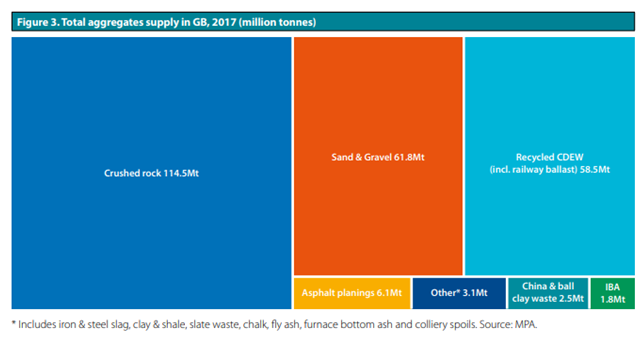
The overall split of Aggregates (for 2017) is summarise on the left from the MPA[1].
Recycled aggregates made up 29% of total aggregates in 2017, with this split 26% Recycled Aggregates and 3% Secondary Aggregates[1].
Quality Protocol for Aggregates from Inert Waste
In order to produce a Recycled/Secondary Aggregate Specification a Quality Protocol entitled 'End of Waste Criteria for the production of aggregate from inert waste' was developed in 2004 by the EA and WRAP in consultation with key stakeholders, including the construction industry.
Its main purpose was to demonstrate how Construction and Demolition Waste could be processed to an appropriate quality and conform with a European Aggregate Product Standard.
The main purposes are/where:
- clarifying the point at which waste management controls were no longer required;
- providing users with confidence that the aggregate they purchase conforms to an approved industry specification defined in accordance with an appropriate European aggregate standard;
- providing users with confidence that the aggregate is suitable for a use within a designated market sector(s) including by conforming with the industry standard; and
- protecting human health and the environment (including soil).
- The Quality Protocol for It can be downloaded from the Mineral Products Association website [2]
Primary Product Uses
The same Quality Protocol sets out in Appendix B the standards and specifications which must be met for Recycled/Secondary Aggregate Specifications. In summary they include:
- Unbound recycled aggregate: for use as Pipe bedding, Drainage
- Unbound recycled aggregate: for use as Granular fill, General fill, Capping
- Unbound recycled aggregate: for use as sub base
- recycled aggregate for concrete
- recycled aggregate for asphalt
- recycled aggregate for hydraulically bound mixtures
- Reclaimed asphalt for use in bitumous mixtures (often termed planings)
Specification
The specification of Recycled/Secondary Aggregate is often also referred to primarily by the particle size of the material, the main ones being:
- 6F4 fine grading 0/32mm recycled aggregate from crushed hardcore from 32mm down to dust. Normally used as bulk fill to build up levels/as a capping layer
- 6F5 coarse grading 0/80mm (previously 6F2 recycled) - recycled aggregate as per 6F4 but from 80mm down to dust.
- Type 1 - recycled aggregate containing concrete and asphalt from 40mm down to dust. Normally used for road and pathway construction
- Fines - a 6mm to dust product. Mainly used to backfill trenches containing cables
- Planings - recycled tarmac/asphalt plannings from roads. Normally used for the preparation of driveways and as a sub base to roads