

Material Recovery Facilities
The Material Recovery Facility (MRFs) category groups facilities that sort, separate and prepare waste streams for onward reprocessing, treatment or disposal – from dry mixed recyclables (DMR) and specific stream waste inputs through to C&D and material facilities.
This includes regulated MFs, material-specific facilities such as glass, plastics, and metals (in the form of cans) but excludes facilities that process WEEE, Batteries and ELV waste types in WikiWaste.
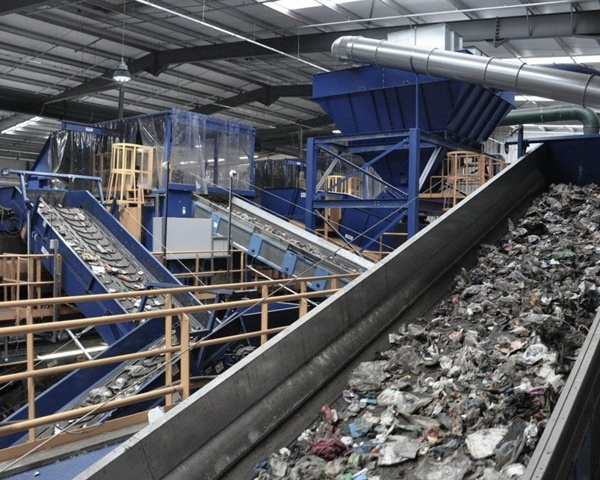
Types of Material Recovery Facilities
There are three main types of MRF, with a further type of MRF in WikiWaste (the MF Facilities) which is defined by legislation and as such it can include some of the other three types of approach used in WikiWaste:
DMR MRFs
Facilities receiving dry mixed recyclables from household and commercial collections – typically fibre-based (paper and card) and containers (plastics, cans, glass) – and separating them into material-specific output streams.
Material-specific MRFs
Facilities captured by legislation, primarily DMR MRFs, but under the definition can include a range of material specific MRFs, and from January 2026 should include bulking and transfer stations that meet the new definitions.
C&D MRFs
Sites focused on construction and demolition wastes (C&D wastes) and primarily focused on skip and ro-ro collected materials. However, these sites may also process excavation wastes – including soil, aggregates and associated recyclables – providing recovery routes that sit alongside landfill and other recovery options.
Over time, Professional-tier tools are expected to support comparisons between these sub-categories, including capacity, throughput and links to Local Authority and commercial collection arrangements.
Schematic of DMR MRF
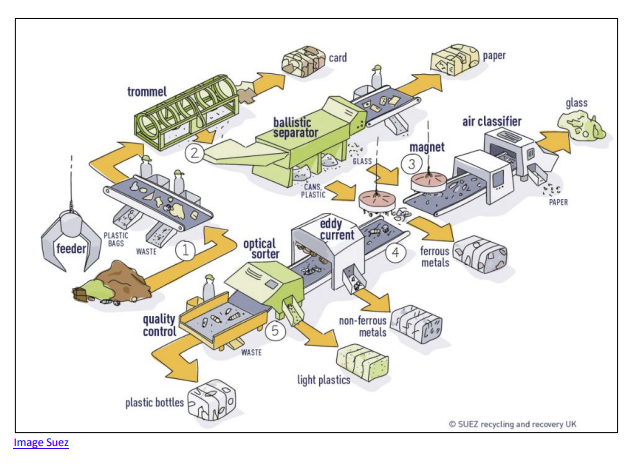
Manual picking by workings also still plays a significant part in the sorting process, although higher degrees of automation, (including robots using AI) are increasing.
Notes
A MRF comprises a number of different stages of sorting technologies, configured in a sequence designed to optimise the sorting of the input material.
The key technologies in the schematic (which are further listed, with page links, at the bottom of this page) include:
- Material Feed (often including a Bag Breaker)
- Trommel Screen
- Ballistic Separator
- Magentic Separator
- Air Knife
- Eddy Current Separator
- NIR Sorting
- Baler(s) to compress recyclabels for onward transport effiencies
Sorting Technology
MRFs are composed of a number of different elements, each with a technological approach designed to sort and/or separate waste in one or more processing stages. When each technology is put together (with connective conveyor belts) it creates the overall MRF solution designed for the input waste in the building/space available at a site/facility. The following list links to a growing range of content on WikiWaste for the technological ‘sorting technologies’ used in MRF design and delivery.
Links to other WikiWaste Sections:
Material Recycling is designed to be read in context with other parts of WikiWaste:
- Local Authorities – showing which disposal and collection authorities send material to particular MRFs and MF facilities.
- Market Approaches – connecting facility roles back to collection systems, contracts, gate fees and service configurations.
- Waste Types – linking waste types such as dry recyclables, C&D waste and certain specific streams into the facilities that handle them.
- Organisations – associating facilities with operators,, local authorities, regulators and sector bodies.
Facility pages indicate where Professional-tier tools are available, including mapped locations, tonnage time-series and simple rankings by throughput or capacity. This allows users to navigate from:
- a single facility to the authorities and contracts linked to it;
- particular streams to the MRF routes they use; and
- more detailed analysis on the tonnage processed, contamination levels and nature of the materials sent out, specifically from MFs
Purpose
Use this page to understand the main types, see how material flows link back to collection systems and local authorities, and navigate to facility and organisation-level views where data is available.
Approach
Approach
Material Recovery Facilities sit between collection systems and downstream reprocessors, EfW or landfill routes. They receive mixed or partially sorted streams and separate them into usable fractions – or, in some cases, produce fuels and residues for further treatment and processing.
Within WikiWaste, this category aims to:
- Group facilities into clear, related types for easier comparison.
- Link sites to Local Authority and commercial collection systems to show where material flows.
- Connect material streams back to the Waste Types section (for example Dry Recyclables and CD&E Wastes categories).
- Highlight tonnage and capacity data where available, noting when figures were last updated and the scope of the data.
Facility pages will indicate the scope of data available for each site, including whether inputs, outputs, capacity estimates and performance metrics are present, together with the year when these data were last updated.
References:
None.