

Landfill
The Landfill category groups facilities that permanently dispose of waste onto and into land into three main types inert, non-hazardous (with and without SNRHW cells) and hazardous landfill sites – with the site selection, engineering, operation, restoration and long term aftercare reflecting the nature of the waste being landfilled.
Landfill remains a critical part of the UK waste system, particularly for certain residual and Construction & Demolition waste streams, even as policy, economics and infrastructure development continue to drive diversion towards recycling and recovery options. Each landfill site, however, has a finite capacity (or ‘void’) that, when filled, leads to the ultimate closure of the site.
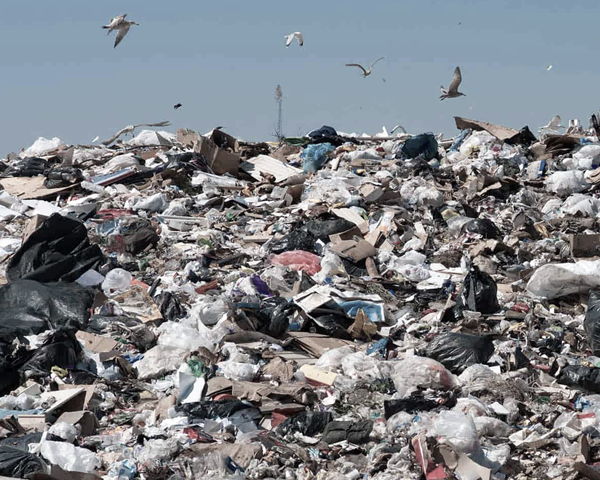
Types within Landfill
Landfill is divided into three types that reflect the definitions under the legislation and the permitting approach taken by the regulators in the UK [1] which primarily reflects the waste types received and their potential to pollute the environment (the waste must meet the relevant Waste Acceptance Criteria – or WAC - for the type of site and each site has specific selection, engineering, operation, restoration and long term aftercare requirements).These can be viewed individually or as part of an overall Landfill picture.
Landfills permitted to accept hazardous wastes under specific conditions, and not permitted to accept non-hazardous waste.There are relatively few of these sites in the UK and therefore they typically serve wider catchments.
Landfills permitted to accept non-hazardous wastes, including municipal and commercial residuals, and meets the relevant WAC. Some of these sites are able to receive with some cells potentially designated for Stabilised Non-reactive Hazardous Waste (SNRHW) in a separate cell if certain criteria are met.
Landfills permitted to accept inert wastes including example soils, subsoils and certain construction & demolition waste that meet the relevant WAC.
These types of sites presently exclude those sites that are managed as sites exempt from permitting. These might include small engineering projects (such as bunds, engineering-related landscape projects, and engineering platforms) that may use exemptions from permitting or CL:AIRE schemes that have an agreed code of practice. This is different to some inert landfills which are exempt from the payment of Landfill Tax due to planning obligations requiring their restoration.
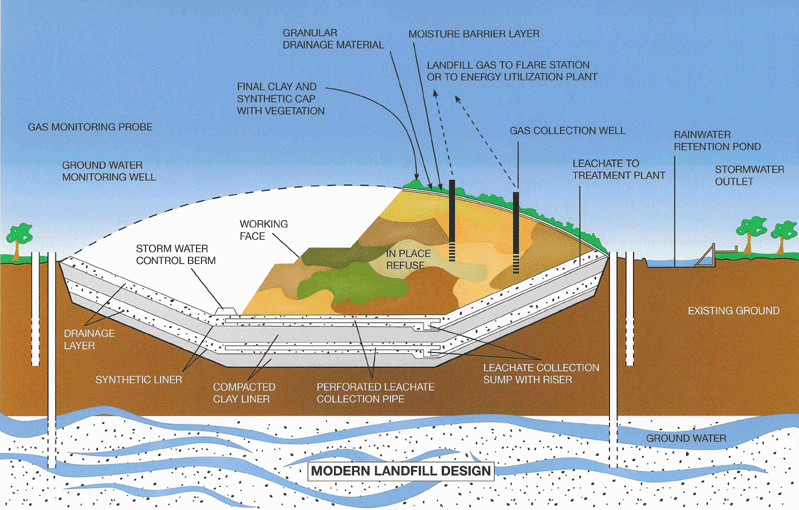
Cross Section of Modern Landfill
Context
The placement of waste in a landfill will slowly degrade over time, and in the case of the presence of Organic Waste within the Residual Waste going to landfill, it will breakdown to produce Landfill Gas and Leachate which have the potential to cause environmental pollution.
As a result the selection of the site and the engineering and containment design is critical to protect the environment, and specifically underlying groundwater.
The cross section on the left[2] captures the main elements of landfill delivery which are captured in this and associated pages in WikiWsste
Key Stages of Landfill
The key stages are managed through from the:
- initial choice of location through to
- the engineering and containment systems
- the operational management
- the restoration and closure of the landfill
- and the monitoring of landfills through each of the above stages
The complexity of the engineering approach and management is based upon the nature of the waste received and the sensitivity of the location of the site.
Landfill vs Land-raise
Landfill sites have usually been constructed in disused quarries, or parts of quarries.
However, the phrase is also used to describe sites built where there had previously been no excavation. Such sites are also known as “land-raise” sites, but in the context of WikiWaste, no distinction has been made.
To all practical intents and purposes, there is no significant difference between landfill and land-raise and the term "Sanitary Landfill" can be applied to both.
Bottom of Hierarchy
Whilst Landfill is the ultimate destination for waste, ideally after all forms of Reuse, Recycling, and Recovery have been undertaken, there will always be a small element of waste that will need to be landfilled in a safe and secure way – and in the case of inert soils and construction and demolition waste it provides a sometimes essential reclamation of a quarry after the extraction of minerals.
In developing countries, with limited infrastructure, the delivery of Sanitary Landfill would represent a huge step forward in protecting water resources and human health.
Targets
Under the Landfill Directive targets were set for the reduction of the landfilling of biodegradable waste by 2020 (which was achieved) and a target of no more than 10% of MSW generated by weight to be landfilled by 2035.
Scotland introduced a ban on the landfill of biodegradable waste which was subsequenlty delayed on two occassions and is now set to be enforced from January 2028. Other countries in the UK are considering similar bans.
Capacity of Non-hazardous Landfill
The capacity of Non-Hazardous Landfill (with and without SNRHW) has been reducing at around 18 to 20 million cubic metres per year since 2015. This reflected rates of landfill exceeding new landfill capacity being bought on stream. At this continued rate of consumption, with no new landfill, this capacity would be filled within 10 years (although the rate of consumption of Non-Hazardous Landfill with SNRHW is being consumed slightly slower).
A paper by the ESA[3] suggests that time-limited planning cosents for landfill need to be changed to allow for fill rates that are progressing slower than what was anticipated when they were consented.
A report for DEFRA published in August 2020 [4] considers void consumption in Non-Hazardous Landfill over future input scenarios based on different recycling and growth rates and the conclusions are in the table to the right.
Parameters
| Stats. | Units/Year | |
|---|---|---|---|
Overall inputs 2013 to 2018 | 27 | million tonnes +/- 1 million (2020) | |
75% of capacity is held at | 36 | number of sites (2020) | |
50% of capacity is held at | 15 | number of sites (2020) | |
Remaining life at current fill rate | 2024 | year at 2018 fill rates (2024) | |
Remaining life at current fill rate | 2028 to 2030 | year at projected fill rates (2020) |
Key Elements of Landfill
The stages of landfill, from site selection, engineering and management through to restoration and aftercare are summaised on the linked pages below
Purpose
Use this page to understand the main landfill types, the capacity, remaining void and regional supply. See how they connect to Local and Waste Types, and navigate to facility level views where more data is available.
Approach
The Landfill category focuses on facilities that accept waste for final disposal, under environmental permits that define which materials are allowed, how they are engineered and how emissions are managed. It covers inert, non-hazardous and hazardous landfill sites, including those with cells for stable non-reactive hazardous waste (SNRHW).
Within WikiWaste, this category aims to:
- Group landfill facilities into clear types based on waste type and permit scope.
- Link landfill routes to Local Authority and commercial arrangements that still rely on landfill for part of their residual or C&D waste.
- Connect landfill back to the Waste Types section, particularly residual, construction & demolition and hazardous waste streams.
- Highlight capacity and remaining void where available, noting when figures were last updated and at what spatial resolution.
Facility pages will indicate the scope of data available for each site, including whether inputs, remaining void, closure status and aftercare details are present together with the year when these data were last updated.
References:
- Environmental Permitting Guidance – The Landfill Directive (Version 3.1 March 2010); updated by Guidance LFD 1 – Understanding the Landfill Directive (March 2011); which was then withdrawn in October 2022 and replaced with Guidance on Environmental Permitting (on gov.uk)
- GOIC Website
- ESA Paper March 2026 - Need for flexibility over landfill end dates
- Financial Costs and Climate Change Impacts of Current and Future Landfill Operations (Report August 2022)