

Residual Waste
Residual waste is the term that encompasses all waste left over after all the Recyclable material has been separated out. Residual Waste is regarded as having too high an economic and environmental cost to further separate, outweighing any benefits created from further separation.
Residual Waste is often described as Black Bag Waste, but the definition above captures a wider definition. The macro DEFRA data[1] does not capture Residual Waste as a category, but the most recent publications by DEFRA[2][3] for England set out more detailed definitions in order to measure a target for the reduction in Residual Waste.

Residual Waste Measurement
The following categories/metrics of Residual Waste are used in different contexts the UK:
- Total Residual Waste
- Residual Waste excluding Major Mineral Wastes (MMW)
- Residual MSW Wastes
- Residual Local Authority Collected Waste
- Residual Waste from Households
Waste Types, Recycling, Recovery and Treatment Approaches Impact Residual Waste Outputs
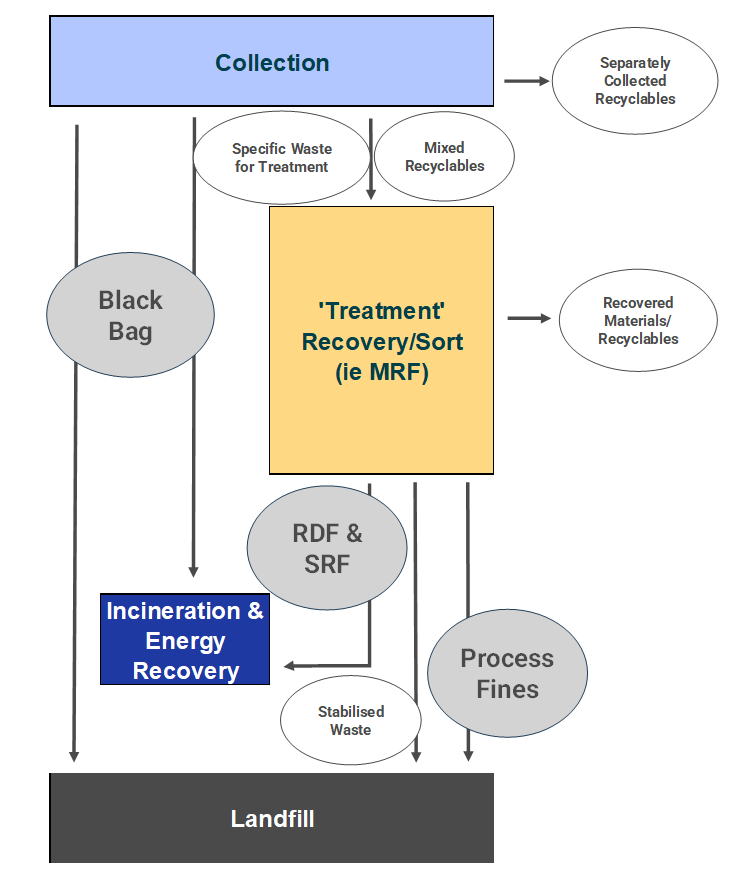
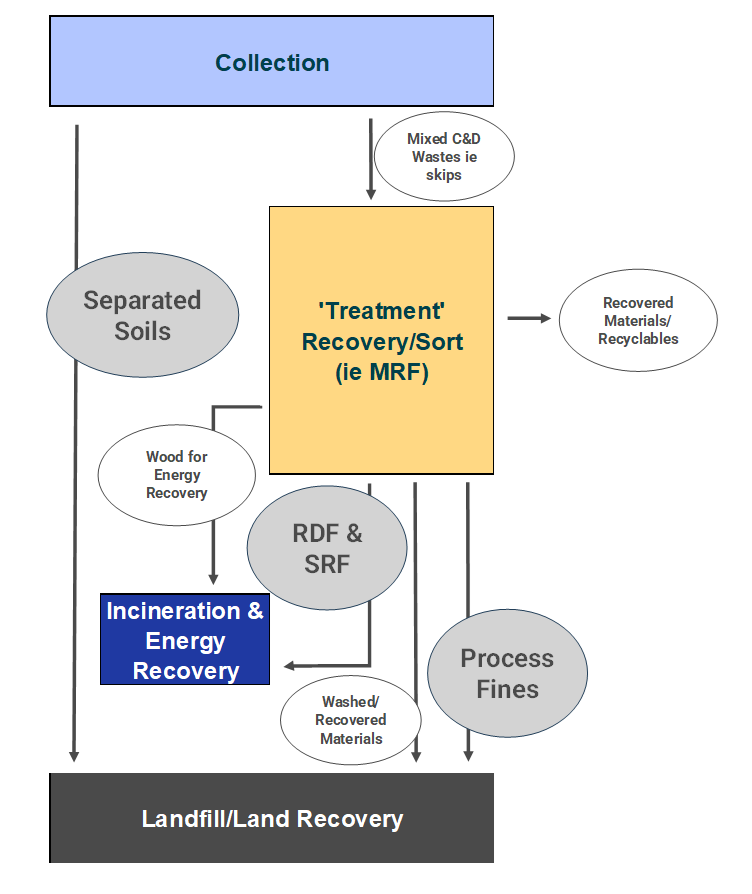
The two schematics below show 4 primary residual wastes in grey.
For the purposes of most of the categories/metrics soils and major mineral wastes are excluded from residual waste reporting.
The type and volume of residual wastes are dependant upon the type of waste and treatment processes undertaken (C&D wastes for example are likley to produce process fines that are more soil-like in nature).
Schematic for Household, Commercial and Industrial Waste and Resultant Residual Wastes
Schematic for Construction and Demolition Waste and Resultant Residual Wastes
Types of Residual Waste
The three main categories shown the schematic above are futher sumamrised below. Residual Waste can contain a wide mix of materials such as plastics, paper and biodegradable materials such as food waste. Residual Waste can be considered a partially renewable energy source when used in Residual Waste EfW and Cement Kilns because a fraction (often up to around 50%) is considered renewable.
Black Bag Waste
Black Bag Waste has had recycling and recovery undertaken at source (for example at the business or the household) and the remaining 'residual waste' is often termed ‘black bag’ waste.
These wastes are predominantly defined under EWC code 20 03 01 and the main EWC-STAT code is 10.1 referred to as ‘household and similar waste’
SRF/RDF Waste Derived Fuels
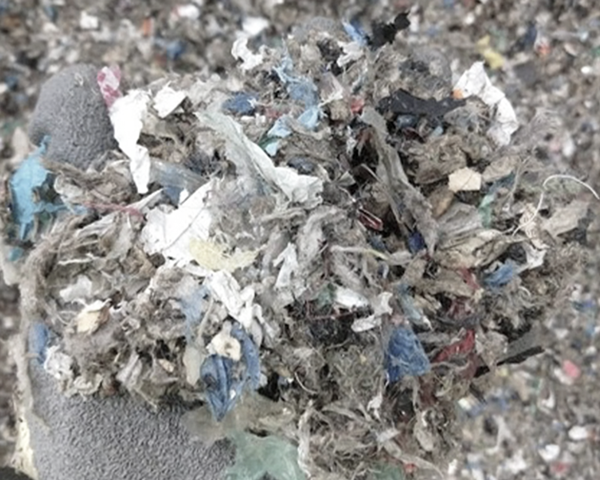
Wastes that have been processed into a fuel for energy recovery can be to different specifications according to the desired use. Refuse Derived Fuel has a wide specification and Solid Recovered Fuel a tighter specification (the latter is often used in cement kiln facilities). A large proportion of this waste category has also been exported outside the UK since 2009.
These wastes are predominantly defined under EWC code 19 12 10 and the main EWC-STAT code is 10.3 referred to as ‘sorting residues’
Process Fines
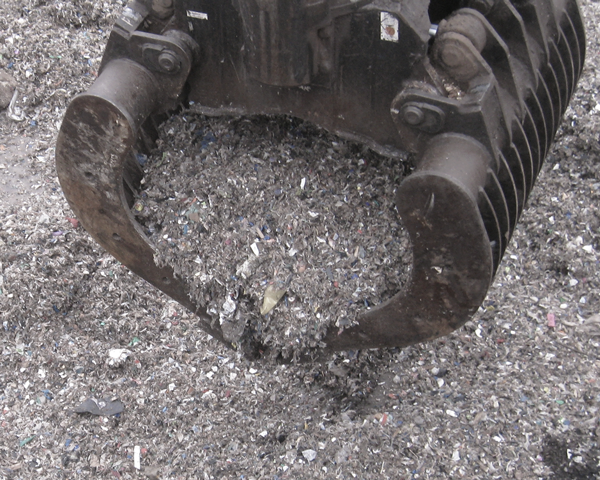
Waste sorting and processing often produces a residue with a small particle size commonly termed ‘fines’ and is currently mainly sent to Landfill. The nature of this material, how it can be treated and the proportion that is combustible (and therefore suitable for Residual EfW) is open to some interpretation in the data.
These wastes are predominantly defined under EWC code 19 12 12 and the main EWC-STAT code is 10.3 referred to as ‘sorting residues’.
Residual Waste UK - Macro Tonnage Interpretation
The following graphs and notes apply a simple calculation to DEFRA data[1] to derive broad analysis of Residual Waste
Total Residual Waste (UK)
Data[1] for 2022 is for England only.
Notes
The DEFRA macro data[1] for treatment for both the UK and England is presented on the basis that Residual Waste excludes those wastes that are reported as recovered (other than energy recovery and land recovery) and:
- Other Mineral Wastes have been excluded (Mining Waste)
- Dredging Spoils have been excluded
Major Mineral Wastes (MMW) as presented comprise C&D Wastes, Combustion Wastes, Soils, and Minerals from Waste Treatment.
Residual Waste Treatment - excluding Major Mineral Wastes (UK)
Data[1] for 2022 is for England only.
Notes
Taking the same approach to the above data, and excluding Major Mineral Wastes (MMW) the DERFRA data[1] displayed in the graph is for treatment via landfill and incineration noting that:
- Landfill includes 'recovery from backfilling' and 'deposit onto or into land'
- Incineration includes those facilities with and without energy recovery
- DEFRA include organic waste tonnage treated via Anaerobic Digestion as energy recovery.
Residual Waste England - Tonnage and Progress Against Target
England has set a target[4] for reducing residual waste (excluding major mineral wastes) to 287kg per person by 2042
Total Residual Waste (England)
The toal residual waste reported for England[2] (including Major Mineral Wastes or MMW) was 59.8 million tonnes in 2023. The figures do not correlate with the DEFRA macro startistics[1] above due some differences in the approach to the calculation.
Notes
- The total residual waste for England (excluding Major Mineral Wastes) was 31.9 million tonnes in 2023 and is the basis of the residual waste target (in kg per person) for England
- Of this tonnage 26.5 million tonnes was MSW residual waste (the balance of 5.4 million tonnes being Non Municpal Waste)
- The most recent DEFRA Residual Waste Infrastrucutre Capacity note[3] was based primarily on MSW residual waste, and the data in this note largely correlates with ref[2]
Residual Waste Treatment - excluding Major Mineral Wastes (England)
Major Mineral Wastes, totalling 27.9 million tonnes in 2023[2], were all treated via landfill and land recovery and are not shown in the graph.
Notes
- Tonnage reported is for all tonnage arisings in England, whether treated in England or other countries of the UK
- Waste to Incineration includes tonnage to Incinerators with Energy Recovery, and Anaerobic Digestion as an Energy Recovery treatment process
- Export outside of the UK is for RDF/SRF for energy recovery
- Figures correlate reasonably closely to the Residual Waste Capacity note for England[3].
Residual Waste (excluding Major Mineral Waste) per person (England)
Notes
- The reference year for the Residual Waste Target (excluding Major Mineral Wastes) is 2019 - when it was 574.8kg per person
- The target for 2042 is to half this figure to 287kg per person
- The projection to meet the target sets an interim target of 437kg per person by 2027 (shown as a linear target in the graph)
- The reported perfromance in 2023 of 558.2kg is 9% behind target, equivalent to c.3million tonnes (based on a back-calculation of population of 57.7 million)[2]