Knostrop Clinical Waste Incinerator
Clinical Waste Incinerator operated by SRCL and located adjacent to Knostrop Treatment Works, Leeds.
The facility has a permitted throughput of 17,500 tonnes per year[1].
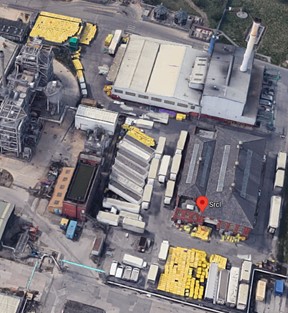
Site Details
| Operator | SRCL |
|---|---|
| Site | Knostrop Clinical Waste Incinerator |
| Permit No | CP3930XL |
| Plated | 17500 |
| Status | Operational |
Plant Description
The incinerator consists of two streams, known as the East and West streams, each with a nominal throughput of one tonne of clinical waste per hour.
The two incinerators are of stepped hearth design, with three main combustion hearths and an ash box.
The permit sets an annual throughput limit of 8,500 tonnes on each stream, with lower limits on specific waste types. The two streams are independent of each other, so that one stream can still be operated while the other stream is shut down for maintenance.
Clinical Waste is loaded mechanically direct from the wheeled bins used to deliver the waste, onto the first hearth, and the combustion process commences. Hydraulic rams operate at intervals to push the waste along the first hearth, until it falls off the end onto the second hearth where the waste burns vigorously at a temperature of between 1000 and 1100 degrees Centigrade.
The waste is then pushed from the second hearth onto the third hearth, where it burns out to produce an ash. This bottom ash is then pushed into an ash box, where the fixed carbon in the ash is further burned out.
The retention time on the hearths is approximately 12 hours, with the bottom ash being retained in the ash box for up to 8 hours before being dropped into a skip. Ram movements are programmed in relation to the number of bins fed[1].
The flue gases from the Incineration process then pass through a secondary chamber, or afterburner, where any gaseous products of Combustion are burned out under oxygen rich conditions.
This stage is designed to destroy any Carbon Monoxide, Volatile Organic Compounds, and dioxins and furans produced by the Combustion process.
The flue gases are then cooled by passing through a waste-heat boiler and economiser, before passing into the final, abatement section of the process.
Powdered lime (Calcium Hydroxide) and powdered activated carbon are added to the flue gases entering the abatement process to remove acid gases, heavy metals and residual dioxins and furans before discharge to atmosphere from the stack.
The flue gases being discharged from the stack are continuously monitored for Hydrogen Chloride, Sulphur Dioxide, Carbon Monoxide, Oxides of Nitrogen, particulate matter (dust), Volatile Organic Compounds, oxygen and moisture content.
The incineration process produces two residues; bottom ash and spent lime. The bottom ash is sent to a recycling transfer station for reprocessing, the bulk of the material ultimately ending up as a landfill cover material. The spent lime, which is the residue from the flue gas abatement process, went to a site in Leeds where it is used to neutralise acidic wastes[1]

References:
- Annual Performance Report 2020