
Ashford Clinical Incinerator
Clinical Waste Incinerator operated by Stericycle (SRCL) and located adjacent to The William Harvey Hospital, Kent.
The plant has a capacity of 8,500 tonnes per year.
The bulk of wastes are clincial wastes from hospitals, but also includes smaller quantities from doctors’ surgeries, dentists, health clinics, residential and nursing homes, and from medical research facilities. The hazardous wastes incinerated include infectious waste and waste containing cytotoxic or cytostatic medicines[1].
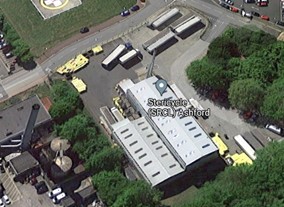
Site Details
| Operator | SRCL |
|---|---|
| Site | Ashford Clinical Incinerator |
| Permit No | HP3230XA |
| Plated | 8500 |
| Status | Operational |
Plant Description
The Incinerator is designed to process 1000 kilograms per hour. The incinerator is of stepped hearth design, with three main combustion hearth and an ash box.
Healthcare Wastes are loaded mechanically direct from the wheeled bins used to deliver the waste. The waste is charged onto the first hearth where the combustion process commences.
Hydraulic rams operate at intervals to push the waste along the first hearth, until it falls off the end onto the second hearth where it burns at a temperature of between 850°C and 1000°C, where it burns out to produce an ash.
This Incinerator Bottom Ash and any remaining part-combusted waste is then pushed along the hearth, where the fixed carbon in the ash is further burned out.
The residues are then dropped into an ash pit the end of the process.
The flue gases from the incineration process are passed through a secondary chamber, or afterburner, where any gaseous products of combustion are burned out under oxygen rich conditions.
This stage is designed to destroy any carbon monoxide, volatile organic compounds, and dioxins and furans produced by the combustion process.
The flue gases are then cooled by directing them through a waste-heat boiler before they pass into the abatement section of the process.
Powdered lime and powdered activated carbon are added to the flue gases entering the abatement process to remove acid gases, heavy metals and residual dioxins and furans before discharge to atmosphere from the stack.
The flue gases being discharged from the stack are continuously monitored.
The incineration process produces two residues; bottom ash and spent lime.

References:
- Annual Report 2024